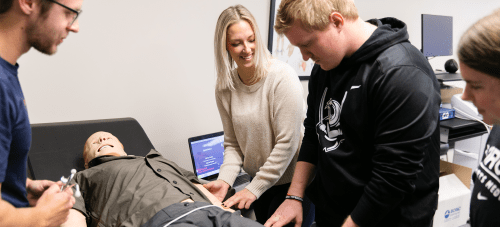
Athletic training faculty and students working together in a simulation lab

Athletic Training: M.S. - Master of Science

The M.S. Athletic Training goes beyond athletics, it's part of the broader healthcare profession. As such, this degree prepares student to work as an athletic trainer and provide a continuum of care along the five domains of athletic training.

At a Glance

Program Results

M.S. - Master of Science

Athletic Training

Career Outcomes

Clinical athletic training positions in a variety of health care settings including (but not limited to) colleges, high schools, professional sports, sports medicine centers, military, physician offices, and clinical settings.

Best Suited To

  • Individuals who have completed a bachelor's degree with a minimum GPA of 3.0.
  • Current undergraduates completing their last year of coursework (degree must be completed prior to starting this degree program in June of the matriculating year).
  • UVA undergraduates currently in the B.S.Ed. in Kinesiology program may qualify to complete the M.S. in Athletic Training program through an accelerated track.

Program Type

  • Full Time

Location

  • In-Person

Estimated Length

2 years (6 semesters). This program begins in the summer and is a full-time year-round program.

Application Deadline

Rolling admission review begins October 1. The final deadline is April 1. 

Applications are due through ATCAS (the Athletic Training Central Application System)

Credits

67

About This Program

The Master of Science in Athletic Training prepares students to become confident, skilled athletic trainers who prevent, evaluate, diagnose, treat, and rehabilitate injuries and medical conditions in physically active individuals. Through integrated coursework, immersive clinical education, and individualized faculty mentorship, students develop the knowledge, clinical judgment, and hands-on experience needed for entry-level practice in a wide range of athletic training and sports medicine settings. 

Athletic trainers work closely with patients, physicians, and other healthcare professionals to improve health, safety, performance, and quality of life. Graduates are prepared to provide evidence-based, patient-centered care and pursue careers in secondary schools, colleges and universities, professional sports, hospitals and health systems, physician practices, military settings, performing arts, industrial organizations, and other healthcare environments. 

The curriculum prepares students to deliver comprehensive patient care across the five domains of athletic training practice: 

  1. Risk reduction, wellness, and health literacy 
  2. Assessment, evaluation, and diagnosis 
  3. Critical incident management 
  4. Therapeutic intervention 
  5. Healthcare administration and professional responsibility

Program Overview

Year 1: Building Foundations & Clinical Confidence

TermSummer I (8 Credits)Fall I (16 Credits)Spring I (15 Credits)
Learning SummaryStudents begin hands-on clinical experiences immediatelyStrong integration of classroom learning with clinical applicationStudents refine decision-making and patient management skills
Skills FocusCore skills and anatomyInjury assessment, therapeutic intervention, and clinical reasoningMedical Management, concussion, and human performance
Courses
  • KINE 5700 Foundational Athletic Training Skills & Emergency Care (4)
  • KINE 5710 Anatomy & Functional Kinesiology (3)
  • KINE 5715 Clinical Practicum I (1)
  • 3-4 week pre-season clinical rotation
  • KINE 5720 Assessment & Intervention of Injury I (4)
  • KINE 5740 Assessment & Intervention of Injury II (4)
  • KINE 5725 Therapeutic Interventions (4)
  • KINE 5745 Evidence-Based Sports Medicine (2)
  • KINE 5735 Clinical Practicum II (2)
  • KINE 5730 Medical Aspects of Athletic Training (4)
  • KINE 5750 Assessment & Intervention of Sport-Related Concussion, Head & Spine (4)
  • KINE 5760 Principles of Strength & Conditioning (3)
  • KINE 5770 Evidence-Based Sports Medicine (1)
  • KINE 5765 Clinical Practicum III (3)

Coursework

To learn more about specific courses taken as part of the completion of this degree, visit the UVA Graduate Record website. The Graduate Record webpages represent the official repository for academic program requirements.

Year 2: Professional Integration & Immersive Practice

TermSummer II (5 Credits)Fall II (12 Credits)Spring II (12 Credits)
Learning SummaryEmphasis on behavioral health and research literacyStudents function in near-independent clinical roles under mentorshipCulminates academic, clinical, and professional development
Skills FocusWhole-person care and scholarly developmentAdministration, leadership, and full-time clinical immersionCareer readiness, advanced performance, and scholarly completion
Courses
  • KINE 6720 Psychosocial Aspects of Athletic Injuries (3)
  • KINE 6745 Translational Research (1)
  • KINE 5775 Clinical Practicum IV (1)
  • KINE 6710 Administration Strategies in Athletic Training (3)
  • KINE 6760 Translational Research (1)
  • KINE 6725 Clinical Immersive I (8)
    • 16+ week immersive clinical experience
  • KINE 6730 Human Performance in Sports Medicine (3)
  • KINE 6740 Athletic Training Seminar (2)
  • KINE 6765 Translational Research (1)
  • KINE 6755 Clinical Practicum V (3)
  • KINE 8999 Thesis or KINE 5993 Independent Study (3)

Coursework

To learn more about specific courses taken as part of the completion of this degree, visit the UVA Graduate Record website. The Graduate Record webpages represent the official repository for academic program requirements.

Admission Requirements

The ATCAS application opens in July of the year prior to enrollment. Applications will be reviewed on a rolling basis starting in October; the final deadline is April 1. Limited scholarships are available; apply early for best consideration. Applicants are responsible for ensuring that all required materials are submitted by the deadline. Incomplete applications will not be read and may be canceled if left incomplete. Materials should be tracked using the checklist in the application system. 

Students may apply to the M.S. in athletic training (MSAT) program in their last year of undergraduate work but must have completed their degree prior to starting in June of matriculating year. UVA undergraduates currently in the B.S.Ed. in kinesiology program may qualify to complete the M.S. in athletic training program through an accelerated track, completing both the B.S.Ed and the MSAT in a total of 5 years. Candidates for the accelerated track must meet the same admission requirements and prerequisites as applicants who apply directly to the MSAT, and are guided by an academic advisor to ensure that all required coursework for the B.S.Ed. will be completed in a three-year period. 

All applications (both accelerated and non-accelerated) to the MSAT are administered through the Athletic Training Centralized Application System (ATCAS), a service of the Commission on Accreditation of Athletic Training Education (CAATE) that is administered by Liaison International (LI) and no GRE is required.

Admission into the program for both accelerated and non-accelerated tracks is highly competitive and is based on the following criteria:

  • Completion of a bachelor’s degree with a minimum GPA of 3.0
  • A resume
  • Two to three letters of recommendation
  • A one to two-page personal statement addressing professional goals
  • Applicants are expected to provide signed proof of completion of a minimum of 50 clinical hours (75 or more preferred) under the direct supervision of an athletic trainer.
  • Completion of specific prerequisite undergraduate courses including:

Required Courses

  • Psychology
  • Biology with lab
  • Anatomy and Physiology with lab (two courses)
  • Physics, Biomechanics, or Human Movement Science
  • Chemistry (no lab required)

Preferred Courses

  • Statistics/Biostatistics
  • Exercise Physiology
  • Nutrition

Application Fee

You will be prompted to pay an application fee as part of your online application. This fee is charged by ATCAS and is not administered by the School of Education and Human Development (EHD); no application fee waivers are available through the school. Information on current application fees and waivers can be found in the ATCAS Applicant Help Center.

Graduate Admission

Applicants should submit their applications via ATCAS as early as possible. For more information about how to use ATCAS, please visit the ATCAS Help Center.

The Clinical Experience

Clinical education is at the heart of the Master of Science in Athletic Training experience. Students apply classroom learning in real-world healthcare settings under the guidance of experienced clinical preceptors, developing the knowledge, confidence, and clinical judgment needed for independent practice.

Three female athletic trainers smiling at camera

First year MSAT students at their clinical site, UVA Field Hockey, with Preceptor Kat Barnes.

Early Clinical Experience

Clinical education begins during the first year of the program, allowing students to develop patient care skills early while connecting coursework with hands-on experience. As students progress through the curriculum, clinical responsibilities increase, providing opportunities to care for a diverse range of patients and conditions while strengthening clinical reasoning, decision-making, and professional confidence.

Team photo of the ice hockey team at Northeastern University

2nd-year immersive experience with Men's Ice Hockey at Northeastern University in Boston, MA.

Immersive Clinical Learning

In the second year, students participate in extended immersive clinical experiences that more closely reflect the pace, responsibilities, and collaboration of professional practice. These experiences help students refine their clinical skills, manage increasingly complex patient cases, and prepare for the transition to independent practice as athletic trainers.

Student athletic trainers on the sideline of a sporting event holding water bottles

2nd-year immersive experience with football at University at Buffalo.

Preparation for Professional Practice

Clinical education extends beyond direct patient care. Students gain experience in healthcare documentation, medical record management, facility and administrative operations, and interprofessional collaboration. Working alongside physicians, physical therapists, and other healthcare professionals, students learn to communicate effectively with patients, families, coaches, and members of the healthcare team to deliver evidence-based, patient-centered care.

Clinical Opportunties

We have opportunities around the country and at various levels of sport participation from collegiate athletics (DI, DII, DIII) to highschools (public, private and boarding) to professional sports team and the military. We also have relationships across athletic conferences including the ACC, SEC, and the BIG10.

UVA Athletics 

  • Football 
  • MLAX 
  • XC/TF 
  • WBALL 
  • MF Tennis/Squash 
  • Softball 
  • WSOC 
  • MSOC 
  • FH 
  • WLAX 
  • Wrestling 
  • Swimming & Diving 
  • Rowing 

Local High Schools 

  • St. Anne’s Belfield School (STAB) 
  • Monticello HS 
  • Western Albemarle HS 
  • Albermarle HS 
  • C’ville High 
  • William Monroe HS (Greene County) 
  • Miller School 
  • The Covenant School

Local Clinics 

  • ACAC 
  • UVA Outpatient Physical & Occupational Therapy 
  • Performance Place PT and Sports Medicine Clinic 
  • University of Virginia Primary Care Sports Medicine Physician Clinic

College/University 

  • Randolf Macon College 
  • Bridgewater University 
  • Radford University 
  • University of Tennessee 
  • University of Denver 
  • NC State University 
  • Penn State University 
  • University of Georgia 
  • University of Michigan 
  • Purdue University 
  • University of North Carolina – Chapel Hill 
  • San Diego State University 
  • Montana State University 
  • Gallaudet University 
  • University of Texas – Austin 
  • Mercer University 
  • Stanford University 
  • Boston College 
  • Northeastern University 
  • University at Buffalo 
  • West Virginia University 
  • United States Naval Academy 
  • University of Central Florida 
  • University of Maryland 
  • Syracuse University 
  • Louisiana State University 
  • Ole Miss

HS/Clinics/Military 

  • Episcopal High School (DC) 
  • Rehab 2 Perform (Annapolis, MD) 
  • Venice High School (FL) 
  • Stratton Mount School (VT) 
  • Fort Liberty/Bragg (NC) 

Professional Sports 

  • Chicago Red Stars (Women’s Soccer) 
  • Charleston Battery (Men’s Soccer) 
  • Kansas City Current (Women's Soccer) 
  • Carolina Panthers (NFL)


Collegiate Residency/Fellowship/Internship 

  • Michigan State University 
  • The Ohio State University 
  • Stanford University 
  • University of Georgia 
  • University of Tennessee 
  • University of South Carolina 
  • University of Memphis 
  • Louisiana State University 
  • Florida State University 
  • Auburn University 
  • Syracuse University 
  • University of Maryland 
  • US Naval Academy 
  • Duke University 

Pediatric Residency 

  • George Mason University

College FTE 

  • Roanoke College 
  • Pittsburg State College 
  • Averett University 
  • Salve Regina University 
  • Louisiana Tech University
  • Michigan State University 
  • Shenandoah University 
  • Randolf Macon College 
  • University of Maryland 
  • University of Kansas 
  • Mount St. Mary University 
  • University of North Carolina - Chapel Hill 
  • Valparaiso University 
  • Utah State University 


Professional

  • LA Chargers (NFL) 
  • Buffalo Bills (NFL) 
  • NY Jets (NFL) 
  • Indianapolis Colts (NFL)

High School 

  • Carrabasset Valley Academy – ME 
  • St. Anne's Bellfield School – VA 
  • The Covenant School – VA 
  • Porter-Gaud School – SC 
  • Jesuit Dallas – TX 
  • Albemarle County – VA 
  • Pine Ridge HS – FL 
  • Charlottesville High School - VA 
  • Annadale High School - VA 
  • Independence High School - VA 

Clinics

  • University of Miami Health System - FL 
  • Sentara Martha Jefferson – VA 
  • Corewell Health Outreach – MI 
  • ACAC – VA 
  • Jordan-Young Institute Orthopedic Surgery & Sports Medicine – VA

Watch Our Video

Turn your passion for health, movement, and sport into a career helping others perform, recover, and thrive. Discover how UVA can prepare you for what’s next in athletic training.

Request Information

Athletic Training Board Certification

Students who successfully complete a degree in Athletic Training from an accredited athletic training program are eligible to sit for the Board of Certification (BOC) examination. BOC certification (ATC) establishes the entry-level credential to work as an athletic trainer. The MSAT program at UVA has an overall 95% BOC exam pass rate.

Learn More about the BOC

Quick Program Facts

95%
Overall BOC Exam Pass Rate
80
Patient Encounters

The typical student has about 80 patient encounters per semester

11%
Employment Growth Rate

Employment of athletic trainers is projected to grow 11 percent from 2024 to 2034, much faster than the average for all occupations, according to the Bureau of Labor Statistics.

6
Semesters

This program is a full-time, 2-year program

80
Clinical Sites

The MSAT program has relationships with over 80 clinical sites across the country

M.S. in Athletic Training FAQs

Request Information

Complete current tuition and fee rates are on the School of Education and Human Development website's tuition and fees page. For the 2026-2027 academic year, the tuition and fees for the MSAT program (summer, fall, and spring) are:

  • $27,358 (Virginia residents)
  • $35,360 (Non-Virginian residents)

Additional program fees include:

  • Clinical software: $90 
  • NATA Membership: $103 
  • Criminal Background Check if needed: $50-$100

Tuition and fee rates are reviewed and updated annually and are subject to change.

The program is fully in person at our campus in Charlottesville, Virginia. This is a two-year, full-time program. Students begin the program in the summer and take classes year round. 67 graduate credits must be earned for the M.S. degree.

Yes. UVA's M.S. in athletic training is accredited by the Commission on Accreditation of Athletic Training Education (CAATE). This 24-month, year-round program is designed to exceed the CAATE standards.  It provides instruction, clinical, and research experiences to prepare students to become certified athletic trainers. Emphasis is placed on didactic coursework, and mentored clinical experience, with opportunities for students to pursue scholarly achievements.

CAATE Program Information and Outcomes

Logo of the Commission on Accreditation of Athletic Training Education (CAATE)

Students who succeed in this program are:

  • Professionally driven students committed to excellence
  • Resilient learners who adapt and grow through challenge
  • Strong time-managers who balance academic, clincals and life
  • Effective communicators who collaborate with confidence
  • Motivated, self-starters who take initiative

Yes! Scholarships are awarded as part of the admission process. Apply early for best consideration. Learn more via our fellowships, scholarships and awards page.

Once you are in the program, there are a variety of scholarships that you can apply for through various athletic training organizations (NATA, MAATA, VATA).

Yes! The program is the priority, so a job should be scheduled around class and clinicals.

You are assigned a second-year student as your mentor within the first month of being in the program. In the fall, you are assigned a faculty mentor. Finally, you are also assigned a faculty mentor and a potential PhD student mentor for your scholarly project.

A full semester (16 weeks) in the fall of your second year. We believe that a full semester provides you a greater opportunity in transition to practice.

Preparation starts on the first day. Additionally, we "test" you with a comprehensive exam each semester that builds with each semester. We teach beyond what is on the BOC because not only do we want you to be competent, but we want you to be ready and confident for the real world. We also provide two practice BOC tests and start your BOC planning process in the summer of your second year.

The average cohort size over the past three years is 16 students.

Program Faculty

Jay Hertel

Jay Hertel

  • Chair, Department of Kinesiology
  • Joe Gieck Professor in Sports Medicine
Michael Higgins

Michael Higgins

  • Professor
  • Athletic Training Program Director
Chris Kuenze Profile Photo

Chris Kuenze

  • Associate Professor
Emily Madrak Profile Photo

Emily Madrak

  • Assistant Professor
  • Director of Simulation, Athletic Training Program
Erin M Moore

Erin M. Moore

  • Associate Professor
  • Athletic Training Clinical Education Coordinator
Jacob E Resch

Jacob E. Resch

  • Associate Professor
Curriculum Vitae Susan Saliba

Susan Saliba

  • Professor

M.S. in Athletic Training News

Accreditation

UVA's M.S. in athletic training is accredited by the Commission on Accreditation of Athletic Training Education (CAATE). This 24-month, year-round program is designed to exceed the CAATE standards.  It provides instruction, clinical, and research experiences to prepare students to become certified athletic trainers. Emphasis is placed on didactic coursework, and mentored clinical experience, with opportunities for students to pursue scholarly achievements.

CAATE Program Information and Outcomes

Logo of the Commission on Accreditation of Athletic Training Education (CAATE)

Disclosures

As a member of the State Authorizations Reciprocity Agreement (SARA), the University of Virginia (UVA) is authorized to provide curriculum in a distance learning environment to students located in all states in the United States except for California. (34 CFR 668.43(a)(6)& 34 CFR 668.72(n)). Although California does not participate in SARA, it allows students to enroll in out-of-state programs.

Upon completion of the M.S. in Athletic Training program at the UVA School of Education and Human Development, graduates may be eligible for initial professional licensure in another U.S. state by applying to the licensing board or agency in that state. Please visit the University’s state authorization web pages to make an informed decision regarding which states’ educational requirements for initial licensure are met by this program. (668.43(a)(5) (v)(A) - (C))

Enrolled students who change their current (or mailing) address to a state other than Virginia should update this information immediately in the Student Information System as it may impact their ability to complete internship, practicum, or clinical hours, use Title IV funds, or meet licensure or certification requirements in the new state. (34 CFR 668.402).

Contact Information